Tuesday, March 1, 2011

?? is MANAGEMENT..


Definition of Management

The term ‘management’ encompasses an array of different functions undertaken to accomplish a task successfully. In the simplest of terms, management is all about ‘getting things done’. However, it is the way and the process of how one achieves ones target or goals and it is in this respect that management is considered an art and a science as well.

The term management may be recently defined, but it existed at a time when men started learning the art of organizing, strategizing (during wars) and/or simply planning. At the core of it, management was quintessentially considered as an art of ‘managing men’ and hence the term “manage-men-T.”

At the roots, management evolved when the definition of knowledge became practically skewed rather than being plain ‘rational’. In some way, Rousseau (1972) pointed out “A real knowledge of things may be a good thing in itself, but the knowledge of men and their opinions is better, for in human society.”

And much later, management scholar, Peter Drucker (1993) defined management as “Supplying knowledge to find out how existing knowledge can best be applied to produce results is, in effect, what we mean by management. But knowledge is now also being applied systematically and purposefully to determine what new knowledge is needed, whether it is feasible, and what has to be done to make knowledge effective. It is being applied, in other words, to systematic innovation.” (Drucker, 1993)

From the above two definitions, it is clear that management is a creative as well as a systematic flow of knowledge that can be applied to produce results by using human as well as other resources in an effective way. Management has not been limited to managing human resource; management today has been segregated into various branches like financial management, strategic management, operations management, time management, crisis management, marketing management etc. Each of these is a separate branch that is being handled by managers who specialize in these fields.

Today the importance of management from an organization’s point of view has increased multifold. It is only through effective management that companies are developing and executing their business’s policies and strategies to maximize their profits and provide with the best of products and services.

Management today combines creative, business, organizational, analytical and other skills to produce effective goal-oriented results! Some of the key functions in management includes learning to delegate, planning and organizing, communicating clearly, controlling situations, motivating employees, adapting to change, constantly innovating and thinking of new ideas, building a good team and delivering results which are not just figure -bound but results that also focus on overall growth and development.

Management focuses on the entire organization from both a short and a long-term perspective. Management is the managerial process of forming a strategic vision, setting objectives, crafting a strategy and then implementing and executing the strategy.
Management goes beyond the organization’s internal operations to include the industry and the general environment. The key emphasis is on issues related to environmental scanning and industry analysis, appraisal of current and future competitors, assessment of core competencies, strategic control and the effective allocation of organizational resources.

In general terms, there are two approaches to management:

-The Industrial Organization Approach: This approach is based on economic theory which deals with issues like competitive rivalry, resource allocation, economies of scale. This approach to management assumes rationality, self interested behavior, profit maximization.

- The Sociological Approach: This approach deals primarily with human interactions. It assumes rationality, satisfying behavior, profit sub-optimality.

Management theories can also be divided into two sets. One is the set that concentrates mainly on efficiency and another is the set that concentrates mainly on effectiveness. Efficiency is about doing things the right way. It involves eliminating waste and optimizing processes. Effectiveness is about doing the right things.

A good management style is a blend of both efficiency and effectiveness. There is no point in acting efficiently if what you are doing will not have the desired effect.

Management techniques can be viewed as either bottom-up, top-down, or collaborative processes.

Porters Five Force Model


A MODEL FOR INDUSTRY ANALYSIS


The model of pure competition implies that risk-adjusted rates of return should be constant across firms and industries. However, numerous economic studies have affirmed that different industries can sustain different levels of profitability; part of this difference is explained by industry structure.
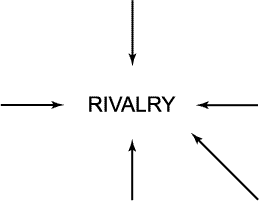
Michael Porter provided a framework that models an industry as being influenced by five forces. The strategic business manager seeking to develop an edge over rival firms can use this model to better understand the industry context in which the firm operates.

Diagram of Porter's 5 Forces

SUPPLIER POWER
Supplier concentration
Importance of volume to supplier
Differentiation of inputs
Impact of inputs on cost or differentiation
Switching costs of firms in the industry
Presence of substitute inputs
Threat of forward integration
Cost relative to total purchases in industry
BARRIERS
TO ENTRY

Absolute cost advantages
Proprietary learning curve
Access to inputs
Government policy
Economies of scale
Capital requirements
Brand identity
Switching costs
Access to distribution
Expected retaliation
Proprietary products
RIVALRY THREAT OF
SUBSTITUTES

-Switching costs
-Buyer inclination to
 substitute
-Price-performance
 trade-off of substitutes
BUYER POWER
Bargaining leverage
Buyer volume
Buyer information
Brand identity
Price sensitivity
Threat of backward integration
Product differentiation
Buyer concentration vs. industry
Substitutes available
Buyers' incentives
DEGREE OF RIVALRY
-Exit barriers
-Industry concentration
-Fixed costs/Value added
-Industry growth
-Intermittent overcapacity
-Product differences
-Switching costs
-Brand identity
-Diversity of rivals
-Corporate stakes 
http://www.quickmba.com/strategy/porter.shtml 

T.P.S

Definition: A Transaction Processing System ( TPS ) is a type of information system that collects, stores, modifies and retrieves the data transactions of an enterprise.

A transaction is any event that passes the ACID test in which data is generated or modified before storage in an information system

Features of Transaction Processing Systems

The success of commercial enterprises depends on the reliable processing of transactions to ensure that customer orders are met on time, and that partners and suppliers are paid and can make payment.

Transaction processing systems offer enterprises the means to rapidly process transactions to ensure the smooth flow of data and the progression of processes throughout the enterprise. Typically, a TPS will exhibit the following characteristics:

Rapid Processing

transaction processing systemsThe rapid processing of transactions is vital to the success of any enterprise – now more than ever, in the face of advancing technology and customer demand for immediate action. TPS systems are designed to process transactions virtually instantly to ensure that customer data is available to the processes that require it.

Reliability

Similarly, customers will not tolerate mistakes. TPS systems must be designed to ensure that not only do transactions never slip past the net, but that the systems themselves remain operational permanently. TPS systems are therefore designed to incorporate comprehensive safeguards and disaster recovery systems. These measures keep the failure rate well within tolerance levels.

Standardisation

Transactions must be processed in the same way each time to maximise efficiency. To ensure this, TPS interfaces are designed to acquire identical data for each transaction, regardless of the customer.

Controlled Access

Since TPS systems can be such a powerful business tool, access must be restricted to only those employees who require their use. Restricted access to the system ensures that employees who lack the skills and ability to control it cannot influence the transaction process.

Transactions Processing Qualifiers

In order to qualify as a TPS, transactions made by the system must pass the ACID test. The ACID tests refers to the following four prerequisites:

Atomicity

Atomicity means that a transaction is either completed in full or not at all. For example, if funds are transferred from one account to another, this only counts as a bone fide transaction if both the withdrawal and deposit take place. If one account is debited and the other is not credited, it does not qualify as a transaction. TPS systems ensure that transactions take place in their entirety.

Consistency

TPS systems exist within a set of operating rules (or integrity constraints). If an integrity constraint states that all transactions in a database must have a positive value, any transaction with a negative value would be refused.

Isolation

Transactions must appear to take place in isolation. For example, when a fund transfer is made between two accounts the debiting of one and the crediting of another must appear to take place simultaneously. The funds cannot be credited to an account before they are debited from another.

Durability

Once transactions are completed they cannot be undone. To ensure that this is the case even if the TPS suffers failure, a log will be created to document all completed transactions.

These four conditions ensure that TPS systems carry out their transactions in a methodical, standardised and reliable manner.

Types of Transactions

While the transaction process must be standardised to maximise efficiency, every enterprise requires a tailored transaction process that aligns with its business strategies and processes. For this reason, there are two broad types of transaction:

Batch Processing

Batch processing is a resource-saving transaction type that stores data for processing at pre-defined times. Batch processing is useful for enterprises that need to process large amounts of data using limited resources.

Examples of batch processing include credit card transactions, for which the transactions are processed monthly rather than in real time. Credit card transactions need only be processed once a month in order to produce a statement for the customer, so batch processing saves IT resources from having to process each transaction individually.

Real Time Processing

In many circumstances the primary factor is speed. For example, when a bank customer withdraws a sum of money from his or her account it is vital that the transaction be processed and the account balance updated as soon as possible, allowing both the bank and customer to keep track of funds.

Further information regarding transaction processing systems can be found at the University of Illinois and John Hopkins University.

what is Human Resources???


Human resources is a term used to describe the individuals who make up the workforce of an organization, although it is also applied in labor economics to, for example, business sectors or even whole nations. Human resources is also the name of the function within an organization charged with the overall responsibility for implementing strategies and policies relating to the management of individuals . This function title is often abbreviated to the initials 'HR'.
Human resources is a relatively modern management term, coined as early as the 1960s - when humanity took a shift as human rights came to a brighter light during the Vietnam Era. The origins of the function arose in organizations that introduced 'welfare management' practices and also in those that adopted the principles of 'scientific management'. From these terms emerged a largely administrative management activity, coordinating a range of worker related processes and becoming known, in time, as the 'personnel function'. Human resources progressively became the more usual name for this function, in the first instance in the United States as well as multinational or international corporations, reflecting the adoption of a more quantitative as well as strategic approach to workforce management, demanded by corporate management to gain a competitive advantage, utilizing limited skilled and highly skilled workers.

For more information you can read it by click the link below...

http://en.wikipedia.org/wiki/Human_resources

Wednesday, February 23, 2011

just want to be like HIM

TUN DR MAHATHIR MOHAMAD


(1981 – 2003)
Born on 20 December 1925 in Alor Setar, the capital of the State of Kedah, Tun Dr. Mahathir did his early and secondary education in his home town. In 1947, he gained admission into the King Edward VII College of Medicine in Singapore.
Upon graduation, he joined the Malaysian government service as a Medical Officer. He left in 1957 to set up his own practice in Alor Setar.
Tun Dr. Mahathir has been active in politics since 1945. He has been a member of the United Malays National Organisation (UMNO) since its inception in 1946.
He was first elected as a Member of Parliament following the General Elections in 1964. However, he lost his seat in the subsequent General Election in 1969. Owing to his keen interest in the country's education, he was appointed Chairman of the first Higher Education Council in 1968, Member of the Higher Education Advisory Council in 1972, Member of the University Court and University of Malaya Council, and Chairman of the National University Council in 1974.
In 1973, Tun Dr. Mahathir was appointed a Senator. He relinquished this post in order to contest in the 1974 General Elections where he was returned unopposed. Following the elections, Tun Dr. Mahathir was appointed the Minister of Education.
In 1976, Tun Dr. Mahathir was made Deputy Prime Minister in addition to his Education portfolio. In a Cabinet reshuffle two years later, he relinquished the Education portfolio for that of Trade and Industry. As Minister of Trade and Industry, he led several investment promotion missions overseas. Tun Dr. Mahathir was elected as one of the three Vice Presidents of UMNO in 1975. In 1978, he won the Deputy President seat and in 1981, he was appointed President of the party. He was returned unopposed as President in 1984.
In the 1987 party elections, Tun Dr. Mahathir defeated his challenger to retain the Presidency and in 1990 and 1993, he was again returned unopposed as party President. Under his leadership, the ruling party Barisan Nasional (National Front) won landslide victories in the 1982, 1986, 1990, 1995 and 1999 General Elections.
Tun Dr. Mahathir is married to a doctor, Tun Dr. Siti Hasmah bt Mohd Ali, and they have seven children Marina, Mirzan, Melinda, Mokhzani, Mukhriz, Maizura and Mazhar.
Tun Dr. Mahathir bin Mohamad became the fourth Prime Minister of Malaysia on 16 July 1981 and stepped down as Prime Minister on October 31st 2003.
Writing is one of Tun Dr. Mahathir Mohamad's passions. He started writing while in school. In the 1940s and '50s, under the pen name "Che Det", he actively wrote articles on Malay politics and economic issues, which were published in The Sunday Times. He continued writing throughout his career, and one of his most famous treatises, The Malay Dilemma (1970), influenced policy and policy makers in the aftermath of the 1969 racial riots.

Tun Dr. Mahathir is also an avid horse rider and enjoys reading fiction. "I read a lot of novels, stories written by well-known authors like Wilbur Smith and Ken Follet. It's a way of avoiding heavy books".

Monday, January 17, 2011

eating or fasting

Malaysia has many kinds of restaurants almost everywhere in the cities and towns. There are Malay Restaurants, Chinese restaurants, Indian Restaurants, Thai Restaurants and more. Eating out in Malaysia is a real gastronomic adventure. There is such a great variety; spicy Malay Food, a seemingly endless variety of Chinese food, exotic cuisine from North and South India, as well as Nyonya and Portuguese Food. Popular Malaysian dishes include satay, nasi lemak, rendang, roti canai, murtabak, laksa, chicken rice, and fried noodles. Western cuisine is also easily available. In addition, international fast food chains operate in major towns side by side with thousands of road side stalls and food bazaars
 
MalayFood                                                                                                    


 Variety is the spice in Malay food. The traditional culinary style has been greatly influenced by the long-ago traders from neighboring countries, such as Indonesia, India, the Middle East, and China. Malay food is often described as spicy and flavorful as it utilizes a melting pot of spices and herbs.
Malay cooking incorporates ingredients such as lemon grass, pandan (screwpine) leaves, and kaffir lime leaves. Fresh herbs, such as daun kemangi (a type of basil), daun kesum (polygonum or laksa leaf), nutmeg, kunyit (turmeric) and bunga kantan (wild ginger buds) are often used. Traditional spices such as cumin and coriander are used in conjunction with Indian and Chinese spices such as pepper, cardamom, star anise and fenugreek. Seasonings play an important role in Malay cooking as they often enhance the food taste and flavors. Many of the seasonings are not dried spices but are fresh ingredients such as fresh turmeric, galangal, fresh chili paste, onions, and garlic. A combination of fresh seasonings and dried spices are normally pounded together to make a fine paste and cooked in oil. Fresh coconut milk is often added.
Rice is the staple diet in any Malay meal. It is often served for breakfast, lunch, dinner, and supper too. Most meals are eaten by using your fingers, and eating utensils are kept to a minimum. All dishes are served at the same time, accompanied by a refreshing drink. Fish is popular in Malay cooking, as with other seafood such as shrimps and cuttlefish. Beef and mutton are very popular choices but never pork as it is against their religious beliefs to eat pork. The other popular white meat is chicken.
One of the most unique Malay dishes is the "roti jala" (lacy pancakes), which sometimes replaces the staple rice. Roti jala is an ideal accompaniment to any dish with lots of rich gravy and is often served during special occasions. It is made from a mixture of plain flour and eggs, with a pinch of turmeric powder and butter. Desserts are a must for any Malay meal. Easily available at most local restaurants and roadside stalls, Malay desserts are invariably very sweet and include ingredients such as coconut milk, palm sugar, and flour.

Chinese Food


The Dim Sum has more than 30 items and includes delights such as the baked egg custard, pan-fried carrot cake, baked cake with sausages and turkey ham, steamed seafood dumplings with shark's fin, steamed soft noodles with shrimps, steamed crabsticks stuffed with fish paste, deep-fried dumplings with salted eggs and red bean paste, and very promising-sounding steamed fresh super prawn dumplings.It is a firm belief that mooncakes are a must during the Mid Autumn or Mooncake festival. The mooncakes are made of six delicious fillings - red bean paste, red bean paste with single egg yolk, lotus seed paste, lotus seed paste with single egg yolk, lotus seed paste with double egg yolks and white lotus with single egg yolk. Some mooncakes are also HALAL or for the Malays who are not allowed to take pork.Freshly cooked mushroom dishes include the mouthwatering grilled shitake mushrooms with chrysterium and special sauce, teapot soup with pine mushrooms, and the succulent grilled shimeji mushrooms.Select from a range of all time favorite Chinese culinary like soups, seafood, poultry, and vegetable dishes. This set of dish promises to trill connoisseurs of Chinese cuisine.

Indian Food
 

Indian influence in Malaysian cuisine started in the 19th century when large arrivals of Indian migrants were brought into the country as contract laborers to work in rubber estates and on the railways. Some did take the opportunity to set up trade in the textile and food industry. Indian cuisine can be divided into two mainstreams, Northern and Southern Indian cuisine.
North Indian cuisine boasts of a diet rich in meat and uses spices and ingredients such as yogurt and ghee in dishes that are elaborate without being overly spicy. Here, bread and chapati (wheat-flour pancakes) replaces rice, which is the center of most South Indian meals. Coconut milk, mustard seeds, and chilies are also widely used in the Southern province.
Spices are the heart and soul of Indian cooking. But the quantity and proportions vary with the geographical boundaries. Curry powder is almost never used. Spices are freshly grounded and added in many different combinations. Spices commonly used are coriander, turmeric, cumin, chilies, fennel, and fenugreek. Other fragrant spices added are cardamom, clove, cinnamon and star aniseed.
In Malaysia, there is an abundant of Indian restaurants and food stalls to whet your appetite. They are traditionally served on a thali, a circular metal tray on which a number of small bowls called katori, also made from metal, are placed. Eaten with fingers, rice or bread are placed directly on the thali while curries and other dishes are served in the bowls. For South Indian cuisine, banana leaves are often used as plates where rice is served in the center, followed by various curries and accompaniments around it. These include dried fish, pappadams (lentil wafers), fresh chutneys made from herbs, coconut, and acid fruits among others.
Local Indian hawkers have created unique versions of local dishes, which are not found in India. For example, "mee goreng" is a combination of fresh Chinese yellow noodles, tofu, bean-sprouts, and dried shrimp paste. Malaysia also abounds with shops offering "Nasi Kandar", which is basically a combination of Malay and Indian cuisine - hence very Malaysian - although the taste is more robust. This concept came about when "nasi" (rice) hawkers would previously "kandar" (balance a pole on the shoulder with two huge containers on both ends) their wares.
Bread is the main item in most meals in North Indian cuisine. Therefore, a wide variety of bread is offered at these restaurants. Nann (leavened bread with poppy seeds) is a popular choice. The bread dough is rolled out and then slapped on the inside of the tandoori, near the top where it cooks very quickly in the fierce heat. It is then flavored with onion or garlic. Paratha, meanwhile, is rich, flaky, and flavored with ghee. It can be eaten as an accompaniment or by itself, filled with potatoes and peas. Chapati is another leavened bread. It resembles flat discs and has a delightful flavor and chewy texture.
Tandoori dishes are the most popular main courses in North Indian restaurants. Tandoori chicken is always a favorite, where a whole baby chicken or chicken quarters are roasted in the clay oven for several hours in advance and then finished off on the barbecue.