Tuesday, March 1, 2011

?? is MANAGEMENT..


Definition of Management

The term ‘management’ encompasses an array of different functions undertaken to accomplish a task successfully. In the simplest of terms, management is all about ‘getting things done’. However, it is the way and the process of how one achieves ones target or goals and it is in this respect that management is considered an art and a science as well.

The term management may be recently defined, but it existed at a time when men started learning the art of organizing, strategizing (during wars) and/or simply planning. At the core of it, management was quintessentially considered as an art of ‘managing men’ and hence the term “manage-men-T.”

At the roots, management evolved when the definition of knowledge became practically skewed rather than being plain ‘rational’. In some way, Rousseau (1972) pointed out “A real knowledge of things may be a good thing in itself, but the knowledge of men and their opinions is better, for in human society.”

And much later, management scholar, Peter Drucker (1993) defined management as “Supplying knowledge to find out how existing knowledge can best be applied to produce results is, in effect, what we mean by management. But knowledge is now also being applied systematically and purposefully to determine what new knowledge is needed, whether it is feasible, and what has to be done to make knowledge effective. It is being applied, in other words, to systematic innovation.” (Drucker, 1993)

From the above two definitions, it is clear that management is a creative as well as a systematic flow of knowledge that can be applied to produce results by using human as well as other resources in an effective way. Management has not been limited to managing human resource; management today has been segregated into various branches like financial management, strategic management, operations management, time management, crisis management, marketing management etc. Each of these is a separate branch that is being handled by managers who specialize in these fields.

Today the importance of management from an organization’s point of view has increased multifold. It is only through effective management that companies are developing and executing their business’s policies and strategies to maximize their profits and provide with the best of products and services.

Management today combines creative, business, organizational, analytical and other skills to produce effective goal-oriented results! Some of the key functions in management includes learning to delegate, planning and organizing, communicating clearly, controlling situations, motivating employees, adapting to change, constantly innovating and thinking of new ideas, building a good team and delivering results which are not just figure -bound but results that also focus on overall growth and development.

Management focuses on the entire organization from both a short and a long-term perspective. Management is the managerial process of forming a strategic vision, setting objectives, crafting a strategy and then implementing and executing the strategy.
Management goes beyond the organization’s internal operations to include the industry and the general environment. The key emphasis is on issues related to environmental scanning and industry analysis, appraisal of current and future competitors, assessment of core competencies, strategic control and the effective allocation of organizational resources.

In general terms, there are two approaches to management:

-The Industrial Organization Approach: This approach is based on economic theory which deals with issues like competitive rivalry, resource allocation, economies of scale. This approach to management assumes rationality, self interested behavior, profit maximization.

- The Sociological Approach: This approach deals primarily with human interactions. It assumes rationality, satisfying behavior, profit sub-optimality.

Management theories can also be divided into two sets. One is the set that concentrates mainly on efficiency and another is the set that concentrates mainly on effectiveness. Efficiency is about doing things the right way. It involves eliminating waste and optimizing processes. Effectiveness is about doing the right things.

A good management style is a blend of both efficiency and effectiveness. There is no point in acting efficiently if what you are doing will not have the desired effect.

Management techniques can be viewed as either bottom-up, top-down, or collaborative processes.

Porters Five Force Model


A MODEL FOR INDUSTRY ANALYSIS


The model of pure competition implies that risk-adjusted rates of return should be constant across firms and industries. However, numerous economic studies have affirmed that different industries can sustain different levels of profitability; part of this difference is explained by industry structure.
Michael Porter provided a framework that models an industry as being influenced by five forces. The strategic business manager seeking to develop an edge over rival firms can use this model to better understand the industry context in which the firm operates.

Diagram of Porter's 5 Forces

SUPPLIER POWER
Supplier concentration
Importance of volume to supplier
Differentiation of inputs
Impact of inputs on cost or differentiation
Switching costs of firms in the industry
Presence of substitute inputs
Threat of forward integration
Cost relative to total purchases in industry
BARRIERS
TO ENTRY

Absolute cost advantages
Proprietary learning curve
Access to inputs
Government policy
Economies of scale
Capital requirements
Brand identity
Switching costs
Access to distribution
Expected retaliation
Proprietary products
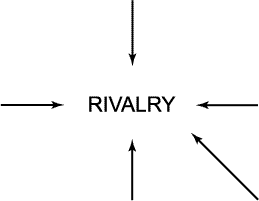
RIVALRY THREAT OF
SUBSTITUTES

-Switching costs
-Buyer inclination to
 substitute
-Price-performance
 trade-off of substitutes
BUYER POWER
Bargaining leverage
Buyer volume
Buyer information
Brand identity
Price sensitivity
Threat of backward integration
Product differentiation
Buyer concentration vs. industry
Substitutes available
Buyers' incentives
DEGREE OF RIVALRY
-Exit barriers
-Industry concentration
-Fixed costs/Value added
-Industry growth
-Intermittent overcapacity
-Product differences
-Switching costs
-Brand identity
-Diversity of rivals
-Corporate stakes 
http://www.quickmba.com/strategy/porter.shtml 

T.P.S

Definition: A Transaction Processing System ( TPS ) is a type of information system that collects, stores, modifies and retrieves the data transactions of an enterprise.

A transaction is any event that passes the ACID test in which data is generated or modified before storage in an information system

Features of Transaction Processing Systems

The success of commercial enterprises depends on the reliable processing of transactions to ensure that customer orders are met on time, and that partners and suppliers are paid and can make payment.

Transaction processing systems offer enterprises the means to rapidly process transactions to ensure the smooth flow of data and the progression of processes throughout the enterprise. Typically, a TPS will exhibit the following characteristics:

Rapid Processing

transaction processing systemsThe rapid processing of transactions is vital to the success of any enterprise – now more than ever, in the face of advancing technology and customer demand for immediate action. TPS systems are designed to process transactions virtually instantly to ensure that customer data is available to the processes that require it.

Reliability

Similarly, customers will not tolerate mistakes. TPS systems must be designed to ensure that not only do transactions never slip past the net, but that the systems themselves remain operational permanently. TPS systems are therefore designed to incorporate comprehensive safeguards and disaster recovery systems. These measures keep the failure rate well within tolerance levels.

Standardisation

Transactions must be processed in the same way each time to maximise efficiency. To ensure this, TPS interfaces are designed to acquire identical data for each transaction, regardless of the customer.

Controlled Access

Since TPS systems can be such a powerful business tool, access must be restricted to only those employees who require their use. Restricted access to the system ensures that employees who lack the skills and ability to control it cannot influence the transaction process.

Transactions Processing Qualifiers

In order to qualify as a TPS, transactions made by the system must pass the ACID test. The ACID tests refers to the following four prerequisites:

Atomicity

Atomicity means that a transaction is either completed in full or not at all. For example, if funds are transferred from one account to another, this only counts as a bone fide transaction if both the withdrawal and deposit take place. If one account is debited and the other is not credited, it does not qualify as a transaction. TPS systems ensure that transactions take place in their entirety.

Consistency

TPS systems exist within a set of operating rules (or integrity constraints). If an integrity constraint states that all transactions in a database must have a positive value, any transaction with a negative value would be refused.

Isolation

Transactions must appear to take place in isolation. For example, when a fund transfer is made between two accounts the debiting of one and the crediting of another must appear to take place simultaneously. The funds cannot be credited to an account before they are debited from another.

Durability

Once transactions are completed they cannot be undone. To ensure that this is the case even if the TPS suffers failure, a log will be created to document all completed transactions.

These four conditions ensure that TPS systems carry out their transactions in a methodical, standardised and reliable manner.

Types of Transactions

While the transaction process must be standardised to maximise efficiency, every enterprise requires a tailored transaction process that aligns with its business strategies and processes. For this reason, there are two broad types of transaction:

Batch Processing

Batch processing is a resource-saving transaction type that stores data for processing at pre-defined times. Batch processing is useful for enterprises that need to process large amounts of data using limited resources.

Examples of batch processing include credit card transactions, for which the transactions are processed monthly rather than in real time. Credit card transactions need only be processed once a month in order to produce a statement for the customer, so batch processing saves IT resources from having to process each transaction individually.

Real Time Processing

In many circumstances the primary factor is speed. For example, when a bank customer withdraws a sum of money from his or her account it is vital that the transaction be processed and the account balance updated as soon as possible, allowing both the bank and customer to keep track of funds.

Further information regarding transaction processing systems can be found at the University of Illinois and John Hopkins University.

what is Human Resources???


Human resources is a term used to describe the individuals who make up the workforce of an organization, although it is also applied in labor economics to, for example, business sectors or even whole nations. Human resources is also the name of the function within an organization charged with the overall responsibility for implementing strategies and policies relating to the management of individuals . This function title is often abbreviated to the initials 'HR'.
Human resources is a relatively modern management term, coined as early as the 1960s - when humanity took a shift as human rights came to a brighter light during the Vietnam Era. The origins of the function arose in organizations that introduced 'welfare management' practices and also in those that adopted the principles of 'scientific management'. From these terms emerged a largely administrative management activity, coordinating a range of worker related processes and becoming known, in time, as the 'personnel function'. Human resources progressively became the more usual name for this function, in the first instance in the United States as well as multinational or international corporations, reflecting the adoption of a more quantitative as well as strategic approach to workforce management, demanded by corporate management to gain a competitive advantage, utilizing limited skilled and highly skilled workers.

For more information you can read it by click the link below...

http://en.wikipedia.org/wiki/Human_resources